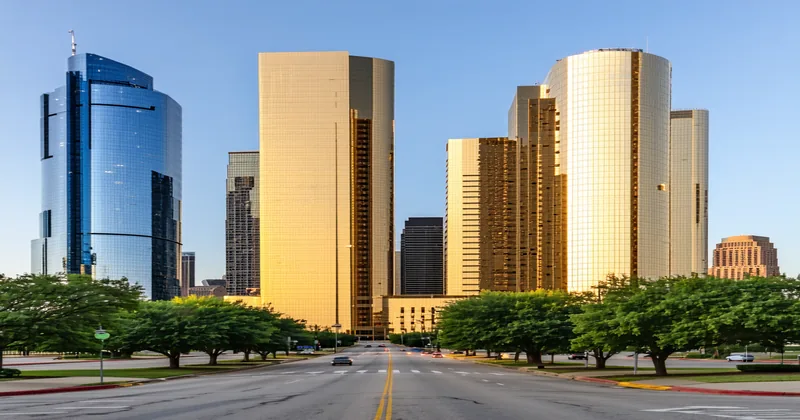
The Dallas–Fort Worth commercial real estate market in the second half of 2025 presented a more differentiated picture than either the bull-case narratives in investor decks or the bear-case concerns circulating in office-market commentary fully captured. Different property types moved at different paces. Different submarkets diverged on vacancy trajectories. And the capital markets narrative — where is institutional versus private investment flowing — played out with specific patterns that had direct implications for leasing strategy in particular submarkets.
This is a synthesis of what the transaction data and brokerage activity looked like in DFW across H2 2025. We're describing what happened in the comp record, not forecasting 2026.
Office: Submarket bifurcation accelerated
The DFW office market in H2 2025 continued the bifurcation trend that had been developing since 2022 — Class A product in high-demand submarkets and Class B/C product in secondary locations moving in divergent directions on both vacancy and effective rent.
Uptown Dallas maintained relatively strong leasing velocity in the Class A segment. The submarket's walkable amenity base, proximity to Turtle Creek, and tenant composition skewed toward professional and financial services firms continued to attract demand. Effective rents — asking rent adjusted for TI and free rent concessions — held within a range consistent with the prior 18 months, with concession packages remaining the primary variable through which landlords and tenants negotiated market conditions. Asking rents in the high $30s per SF full-service gross were achievable for premium floors in well-amenitized Class A towers; effective economics were somewhat lower after accounting for market-standard concession packages.
Preston Center remained a tight micro-market by DFW standards. The limited building inventory and consistent demand from professional services, financial advisory, and healthcare-adjacent office users kept availability constrained. Marketing periods for well-priced spaces in this micro-market remained short compared to the broader metro average.
Las Colinas presented a more complex picture. Class A product near the Urban Center and with direct DART connectivity continued to see competitive interest. Class B product in peripheral Las Colinas locations — buildings without major amenity packages, with older mechanical systems, in areas with lower walkability — faced elevated vacancy and extended marketing periods. For landlords in that segment, the leasing strategy conversation in H2 2025 centered on whether concession packages alone could compete for tenants who had genuinely good Class A options at moderately higher gross rents, or whether asking rent reduction was necessary to clear occupancy.
The Stemmons Corridor — historically a value-play submarket for price-sensitive office tenants — saw continued headwinds. Older Class B and C product in the Stemmons submarket has faced structural challenges as tenants who previously occupied that product have migrated to newer suburban alternatives. Transaction velocity in the submarket was lower in H2 2025 than the prior year.
Industrial: Supply normalization after the 2021-2023 demand spike
The DFW industrial market in H2 2025 was in a normalization phase following the demand and rent spike that characterized 2021–2022. Vacancy rates across major industrial submarkets — DFW Airport, South Stemmons, GSW/Great Southwest, and Mesquite — had risen from the historically tight levels of 2021–2022 as a significant volume of new construction delivered into a market where e-commerce demand growth had moderated from its post-2020 pace.
The DFW Airport industrial submarket remained the tightest in the metro for bulk distribution facilities over 200,000 SF, driven by the submarket's logistical advantages and the infrastructure concentration around DFW International Airport. Asking rents in the NNN range for large-bay Class A bulk product held at levels that would have seemed implausible five years earlier, though rent escalation pressures on new leases moderated compared to the 2022 peak.
The GSW industrial corridor saw more meaningful vacancy increase as new supply delivered in the 50,000–150,000 SF mid-bay segment. Tenants in that size range had genuinely more options than at any point since 2019, and the negotiating dynamic on TI and free rent abatement shifted accordingly. Industrial TI packages, which are structurally lower than office TI, were nonetheless higher in H2 2025 mid-bay industrial negotiations than they had been during the supply-constrained period.
For regional CRE teams working industrial requirements in DFW, the key analytical distinction in H2 2025 was between bulk distribution (where supply/demand remained tighter) and mid-bay logistics and flex industrial (where supply increase had shifted negotiating leverage toward tenants). Treating "DFW industrial" as a single market narrative missed this segmentation.
Retail: Convenience and service-oriented uses holding; traditional formats under pressure
DFW retail in H2 2025 reflected national trends with local intensity. Service-oriented retail — medical and dental services, urgent care, personal services, food and beverage — continued to perform well on leasing velocity and vacancy. Power centers and community centers anchored by grocery, home improvement, and discount formats maintained occupancy better than regional mall-adjacent retail or inline retail in centers without strong anchors.
Transaction volume in DFW retail investment sales in H2 2025 was supported by continued interest from private capital in service-oriented retail assets in strong trade areas. Institutional capital was more selective — focused on grocery-anchored strip assets with long-term lease structures in high-population-growth corridors including the northern suburbs (Frisco, McKinney, Allen) where household formation rates remain above the DFW average.
Capital flows and what they mean for leasing strategy
Tracking capital flows through the DFW investment sales market — using MSCI Real Assets (RCA) data on transaction volume, buyer type, and cap rate trends — provides useful context for leasing professionals even when their deal work is in leasing rather than investment sales. A landlord under institutional ownership with an active capital markets strategy behaves differently in lease negotiations than a private owner carrying a building that needs occupancy to support refinancing. The ownership capital structure affects who makes leasing decisions, how quickly they move, and what their priorities are on rent versus credit versus lease term.
In H2 2025, DFW continued to attract private capital into value-add acquisitions in the office sector — buyers underwriting repositioning plays on Class B assets in submarkets with strong submarket fundamentals at pricing that reflected distressed occupancy. Those acquisitions typically come with capital expenditure plans and a leasing strategy that involves below-market rents or generous TI packages to rebuild occupancy quickly. For tenant reps working requirements in those buildings, understanding the ownership context changes how to read a landlord's motivation and timeline.
What brokerages are hearing from principals
The broker-level view of the market in H2 2025 added texture that transaction data alone doesn't capture. Tenant requirements from professional services and financial firms in the Dallas market through the second half of 2025 were more often right-sizing decisions — consolidating from multiple floors to one, or from one building to a spec suite in a newer building — than growth-driven expansions. The growth leasing that did occur was concentrated in specific sectors: healthcare-adjacent professional services, energy sector advisory, and technology-adjacent firms that had grown through the hiring cycle of 2023–2024.
Landlords in the Class A segment — particularly those with buildings that had been well-managed through the prior market cycle and had maintained amenity investment — were being selective about credit quality on longer-term leases. The era of taking any tenant to fill vacancy regardless of credit profile had passed for institutional-grade assets, even at current vacancy rates.
The regional brokerage firms that navigated H2 2025 most effectively were the ones with granular submarket data and current comp knowledge. Market-level DFW headlines were directionally useful but not sufficient for the specific negotiating conversations their clients needed. That submarket-specific precision — knowing what Q3 2025 effective rents looked like in the La Villita section of Las Colinas versus the Urban Center, or what mid-bay industrial TI packages were clearing at in South Stemmons — is what turns a broker's local market reputation into a defensible analytical position at the table.
If you'd like to see Cremdeal's submarket transaction data pulled against your specific DFW submarkets and active requirements, request a demo.